
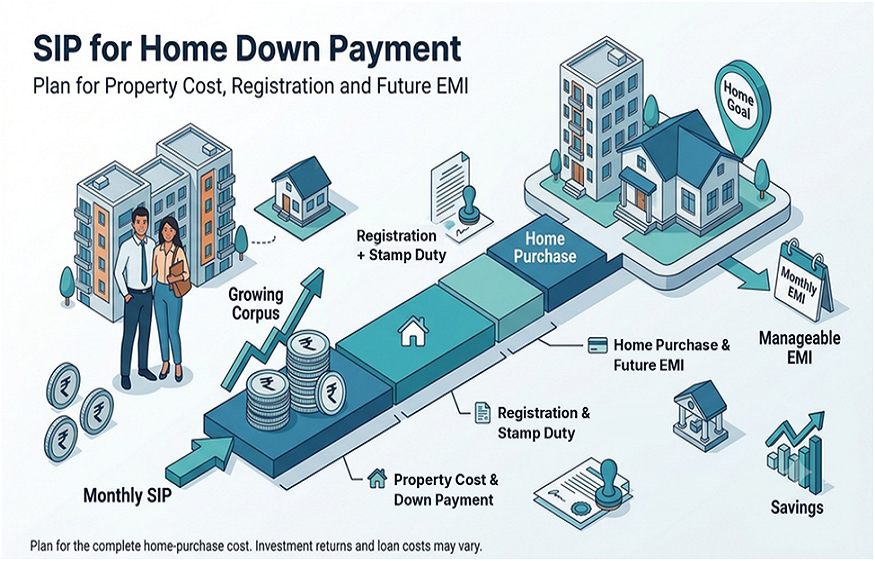
Buying a home is often treated as a simple down-payment goal. However, the actual amount required is usually much higher than the upfront contribution toward the property. Along with the down payment, a buyer needs to account for registration and other purchase-related costs, while also ensuring that the future home-loan EMI remains affordable.
This is where a SIP for home down payment can become a structured way to build the required corpus over time. Instead of focusing only on the property price, the planning should consider the complete cost of buying and financing the home.
Start With the Total Property Cost
Suppose you are planning to purchase a property worth ₹80 lakh. If the lender finances 80%, you may need to arrange around ₹16 lakh as your own contribution. But stopping the calculation here can lead to an underestimation of the actual requirement.Depending on the state and transaction, you may also have to pay stamp duty, registration charges, and other applicable costs. There could also be expenses related to brokerage, documentation, interiors, or moving.
Therefore, rather than setting a SIP target based only on the down payment, estimate the total initial cash requirement.
For example:
- Property value: ₹80 lakh
- Potential down payment: ₹16 lakh
- Registration and related charges: ₹5–7 lakh*
- Other initial expenses: ₹2–3 lakh*
- Target corpus: approximately ₹23–26 lakh
*Illustrative figures only. Actual charges and expenses vary by location, property type and transaction.
Use SIP to Build the Corpus
Once the target is known, the next step is to determine how much you need to invest every month. A sip calculator can help estimate the monthly SIP required based on your target corpus, investment horizon and assumed rate of return. Assume your target is ₹25 lakh and you have five years before purchasing the property. Instead of keeping the entire amount as idle cash from the beginning, you could consider a suitable investment strategy aligned with your five-year horizon and risk tolerance.
For illustration, if an investment were to generate an assumed annualised return of 10%, a monthly SIP of roughly ₹32,000 for five years could accumulate around ₹24.8 lakh. This is only a mathematical illustration; mutual fund returns are market-linked and not guaranteed.
The important point is to work backwards from the goal: property cost → upfront contribution → additional purchase costs → target corpus → monthly SIP.
Read More: Easy Quick Cash Loans Online for Urgent Needs
Don’t Ignore the Future EMI
A common mistake in house planning is successfully accumulating the down payment but overlooking whether the resulting EMI fits comfortably within the household budget.
Suppose you purchase an ₹80 lakh property and take a ₹64 lakh home loan. At an illustrative interest rate of 8.5% for 20 years, the EMI would be approximately ₹55,500 per month.That EMI needs to be evaluated against your expected future income, existing loans, regular expenses, insurance premiums, investments and emergency-fund requirements.
Your house should not become affordable only because you managed to accumulate the down payment. The entire financing structure needs to remain sustainable after purchase.
Keep the Goal Flexible
Property prices can change significantly during a five-year planning period. A house that costs ₹80 lakh today may cost considerably more when you are ready to buy. Consequently, review your SIP periodically rather than treating the initial amount as fixed. Salary increases, bonuses or changes in the expected property price can be used to revise contributions.
A SIP for house down payment should also be kept separate from your emergency fund and other important financial goals. Using emergency savings to bridge a down-payment shortfall can leave you financially vulnerable after purchasing the property.
Think Beyond the Down Payment
The right way to plan for a home is to view it as a three-part financial commitment:Property Cost + Purchase Costs + Future EMI
Your SIP primarily helps you prepare for the initial corpus, while your income and overall financial plan determine whether the subsequent loan repayment is manageable.Before starting a SIP, define the expected purchase price, estimated down payment, registration and other costs, investment horizon and desired EMI. Revisit these assumptions as your income and property plans evolve.
Read More: Business Loans for Women Entrepreneurs: Schemes, Eligibility and How to Apply
A well-planned SIP for home down payment is therefore not simply about accumulating a lump sum. It is about preparing for the complete financial journey of becoming a homeowner without allowing the purchase to disrupt your broader financial stability.
Disclaimer: This article is for educational purposes only and should not be considered investment advice. Mutual fund investments are subject to market risks. Returns are not guaranteed. Consider your financial goals, risk tolerance and investment horizon before investing.